
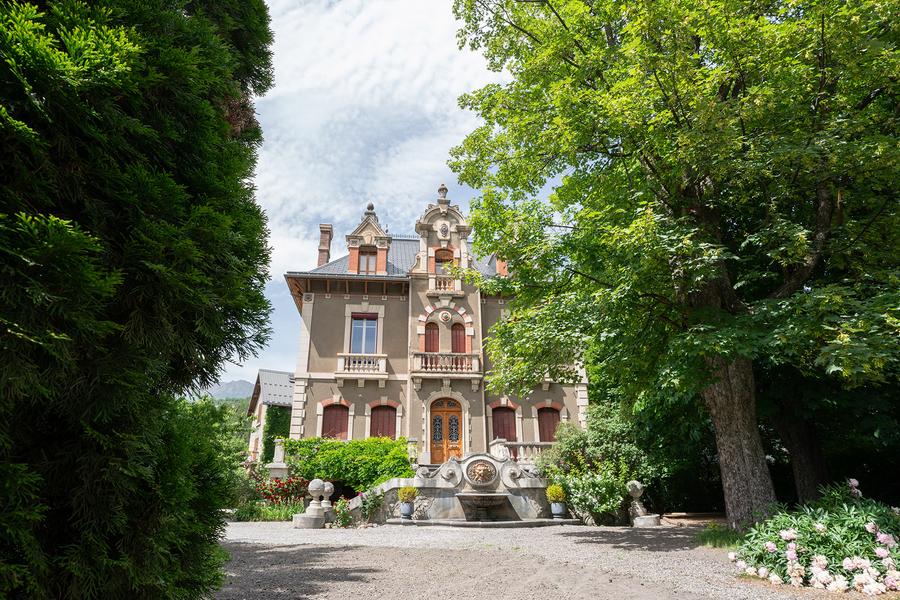
The Villa de La Fontaine, commissioned by Joseph Pinoncély in 1903, is the work of the architect Ulysse Bertrand, an employee of the PLM railways and associated with the construction of the line linking Chorges to Barcelonnette.
Description
Two preliminary projects dated 1903, in an eclectic style, favored a “silhouette effect” accentuated with attics with complex shapes.
The project chosen by the client, a former trader in Durango, keen to achieve greater simplicity, marks a return to the regularity of the plan and elevation.
Ulysse Bertrand then chose to concentrate on the south facade, both on the street and the garden, the bulk of the decorative repertoire, which combines, in a picturesque neo-Flemish style, molded stone, brick and ceramic products. The emphasis is placed on the central bay, treated as a projection and crowned by an imposing dormer window where the year of construction is inscribed, in an enameled terracotta medallion, the year of construction: 1905.
Inside, the main staircase, suspended from three straight flights, exceptionally constructed of marble, occupies the right half of the vestibule. The English ironwork of the railing features a Rococo-style design. Located in the longitudinal axis of the staircase, the bay window composed of four panels is adorned with geometric glasswork decoration against the background of which two armorial medallions stand out.
The other highlight lies in the staging of the steps: a grand staircase with converging ascents and a rest area, decorated with a fountain attached. The medallion, a lion mask encircled by two olive branches in enamelled terracotta, could come from the large tile factory of Burgundy Montchanin (Saône-et-Loire).