
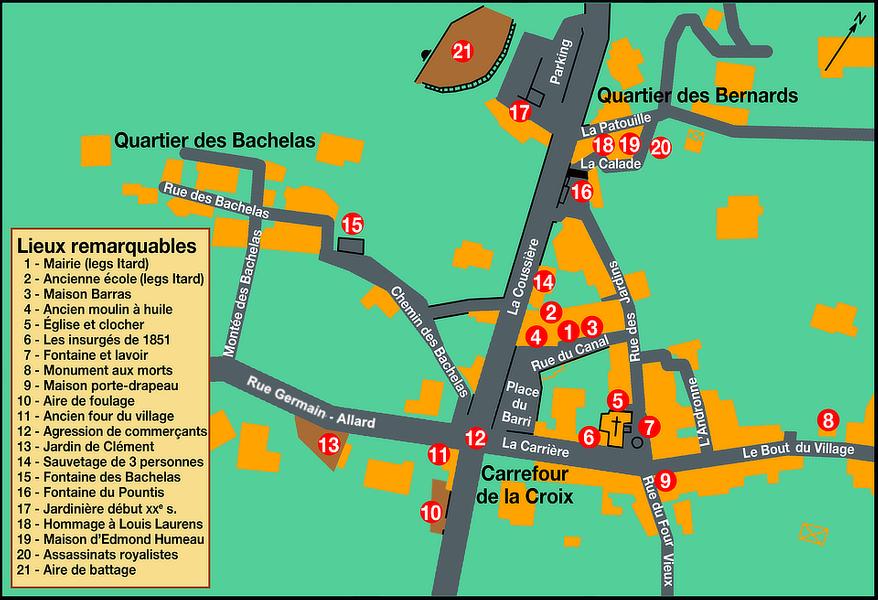
Come and discover the historic route of Castellet.
Commemorative plaques on facades remind Castellians and visitors of the richness of our village's past.
Description
Twelve plaques honor personalities, explain historical events or recall the past of certain buildings.
Route (see map):
1 and 2 - Silvère and Fortunée Itard, offer a town hall and a school to Castellet - Silvère Itard, justice of the peace and mayor of Castellet, who died childless, bequeathed this house with its garden and outbuildings to the commune to install, after the death of his wife, the town hall offices and the school.
3 - Birthplace of René Barras, Mayor of Le Castellet from 1965 to 2002 - René Barras was born here in 1927, and remained Mayor of Le Castellet until his death in 2002. This house, acquired by the municipality, houses the community center and a rental apartment. The ground floor is also used for exhibitions.
4 - The oil mill in operation until the war of 14 - This building was in past centuries a "blood mill", powered by animal power. Today only the press, its chapel and its wall of force remain, to resist the pressure when crushing the olives.
5 - Saint-Pierre Church, 900 years of transformations - In 1178, the Castellet church was built by the Villeneuve-les-Avignon abbey. During its enlargement in 1622, the original apse was demolished. Finally, in 1995, major works were carried out by the municipality to restore the building, which was then in a pitiful state.
The 19th-century bell tower, a rather tumultuous construction site - In 1849, the architect Louis Dellasanta was commissioned to add a bell tower. Work began in September 1852. But following torrential rains, the walls collapsed. The bell tower was not completed until 1854. The 1671 bell was then raised to 13 meters.
6 - The insurgents of 1851, five Castellians condemned - Pascal Bicaïs, Jean Louis Hypolite Brémond, Louis Jean Baptiste Durand, Antoine Guichard, Louis Joseph Tourniaire, five inhabitants of Castellet who participated in the Bas-Alpine insurrection following the coup d'état of Louis-Napoléon Bonaparte on December 2, 1851, were imprisoned in Digne and condemned. Honor to these defenders of the Republic!
7 - Fountain and wash house in the Church Square - The fountain in the Church Square was the second to be built, in 1860-1861. It is the only one in the village to have a central layout and not to be built against a wall. As for the wash house, built against the facade of the church, it was built 23 years later, in 1884, at the urgent request of the inhabitants of the village center.
8 - War Memorial - This war memorial was built in 1919 on land donated to the town by Théophile Reboul in tribute to the eight Castellians killed during the First World War.
9 - Flag-bearing house - On December 26, 1848, the municipal council chose this house – because of its central location – to install the tricolor flag offered to the municipalities by the Republic.
10 - Treading Floor - To circumvent the tithe owed to the clergy for treading wheat on their land, peasants set aside floors on their own land in the 19th century. This one is still well preserved and you can see the stone rollers pulled behind a horse to crush the grain.
11 - Castellet bread oven, the last bakers in the village - This was the oven. The shop was a little further down Rue de la Carrière. The last bakers of the 20th century were Mr. Richebois (until 1930), Mr. Sanchez (until 1936), Mr. Gaze (until 1950), Mr. Jourdan (until 1958) and Teddy (until 1960).
12 - Robbery and assault of traders at the crossroads of the Cross - From the 16th century until the end of the sixties, a large wooden cross, more than 3,50 m high, stood at this crossroads. It was there that on 9 Messidor Year IX (24 June 1801) a group of brigands attacked and stabbed eight traders returning from the Valensole fair.
13 - Clément's garden - This former garden of their husband and father Clément Giraud (1920-2006) – was offered to the town by Lucette and Annie Giraud so that children and families could spend pleasant moments of play and relaxation there.
14 - Act of devotion and courage - Antoine Frédéric Barras, road mender, was awarded the medal of honor under the Second Empire, for having, "on June 14, 1866, saved, at the risk of his life, two women and a young child whose home had just been invaded by the waters" of the flooded Coussière torrent.
15 - Bachelas Wash-house Fountain - Built in 1884, the same year as the wash-house in the Place de l'Église, this fountain-watering trough-wash-house was financed by the local residents themselves and not by the municipality.
16 - Pountis Washhouse Fountain - This is the first watering place in the village, built in the 17th century. At that time, it was simply a fountain with two basins and two cannons. The washhouse was added in 1833 and the roof in 1896. The pountis, which overlooks the passageway on Rue de la Calade, is an archway dating from the medieval period.
17 - An early 20th-century planter - This horse-drawn vehicle from the beginning of the last century was used to transport fruit and vegetables during the week and allowed the family to go for a walk on Sundays. This planter was donated to the town by René Barras and his wife.
18 - Louis Laurens (1780-1837), renowned pharmacist and chemist - Louis Laurens, born in Le Castellet, studied pharmacy in Paris, earned a doctorate in Montpellier, and taught chemistry in Marseille. A hospital inspector and member of the Academy of Sciences and the Medical Society, he died of cholera in Marseille.
19 - L'Humeaudière, a poet's haven - Edmond Humeau, a man of letters, poet and resistance fighter born in 1907, made this residence, from 1953 until his death in 1998, a retreat for reflection and friendship, welcoming the greatest artists and writers of the 20th century.
20 - Murders at Castellet, Republicans Victims of Royalists - On 25 Thermidor, Year V (August 12, 1796), forty-two royalists from Oraison killed – in his house which stood here – an old shoemaker, Crespin Meynier, with a shot to the head fired from across the street. Young Brémond, 15, was murdered with three stab wounds.
21 - Threshing floor - This threshing floor, called Brès, is the oldest in the village, built in the 16th century on this privileged location: high above the village, it benefits from prevailing winds allowing the threshing of cereals with a flail.
Rates / opening
Prices
Free access.
Opening
From 01/01 to 31/12 every day.