

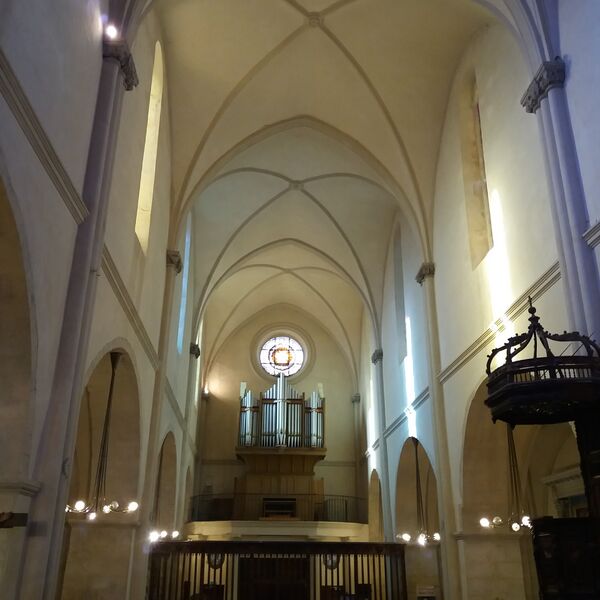
Parish church. The church of Valensole dominates the town with its imposing mass, surprising for a simple parish church (length: 44 m, width: 17 m, height under vaults: approximately 25 m).
Description
Its importance is explained by the fact that it was the seat of a priory of the Abbey of Cluny. Valensole claims to be the homeland of Saint Mayeul, its illustrious abbot. A castle chapel was built in the 10th century on the hill and dedicated to Saint Maxime, Bishop of Riez, a diocese of which Valensole was a part. At the request of Mayeul's successor, Saint Odilon, Bishop Almerade recognized, around 1010, the free possession of the church and the monastery established near it to the Cluniac monks. Saint-Maxime was replaced in the 12th century by a new church, dedicated to Saint Denis. This modest church still exists, rather badly damaged, against the southern flank of the choir of the great church, of which it serves as a vestibule towards the "courtyard of the Deanery". Under the demographic pressure, the population of Valensole and the abbot of Cluny agreed to build a new church of larger dimensions, which was placed under the patronage of Saint Blaise.
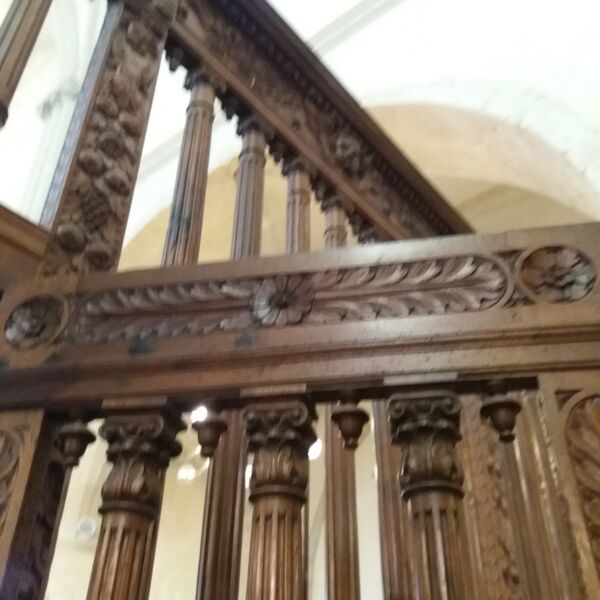
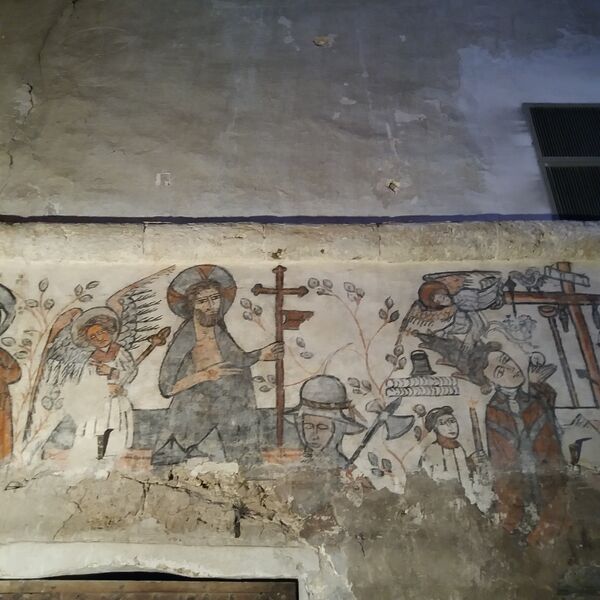
This is a very interesting Gothic construction in a region that has few examples. The construction sites of Avignon at the time of the Popes communicated a remarkable impulse to all of Provence. The choir and the bell tower appear to have been erected in the 14th century. An agreement was made in 1322 for the casting of four bells, one for each bay of the bell tower. Two documents from the municipal archives, dated 1346, indicate that people were then concerned with the construction of the walls of the nave and the side aisles. The style of the capitals with masks and small leaves forming a frieze, the profile of the ribs of the vaults of the choir and the side aisles are consistent with this period. The choir ends with an austere flat chevet, according to an archaic formula dear to the region. This is pierced by a single large bay cut by mullions. The church suffered from the Wars of Religion, particularly the heavy, oblong bell tower raised over the choir, which was transformed into a fortress, which led to its demolition. In 1583, the municipality commissioned a master "peyrier" from Forcalquier, Claude Gayon, to build a small bell tower in the southeast corner of the chevet, on the buttress, to house the town clock. In 1910, this cracked bell tower was demolished and the clock reassembled in the same place, with its pretty 18th century wrought iron bell tower. It contributes to the picturesque silhouette of the church. In the 17th century, a chapel was added to each side of the last bay of the nave; to the north, the Rosary Chapel, in 1640; to the south, an identical chapel, dedicated to Saint Joseph, in 1661-1664. The late Gothic ribbed vaults, popular in the South of France, especially in monastic buildings, were adopted for them. In the 18th century, major works were necessary; they were constantly postponed due to quarrels between the commune, the abbot of Cluny and the sacristan, between whom the expenses had to be divided. In 1786, the church had to be closed for safety reasons. It was not until 1857 that a general restoration was carried out. Ribbed vaults were launched on the nave, claiming to imitate those of the side aisles, but bringing them to the same height as those of the choir, which required raising the gable walls and the gable of the facade by about 4 meters, the original nave being lower than the sanctuary. The restoration, then executed economically, is not on a par with the beauty of the carefully crafted walls of the chevet. The church houses interesting furnishings.
Rates / opening
Prices
Free access.
Opening
From 01/01 to 31/12 every day.