
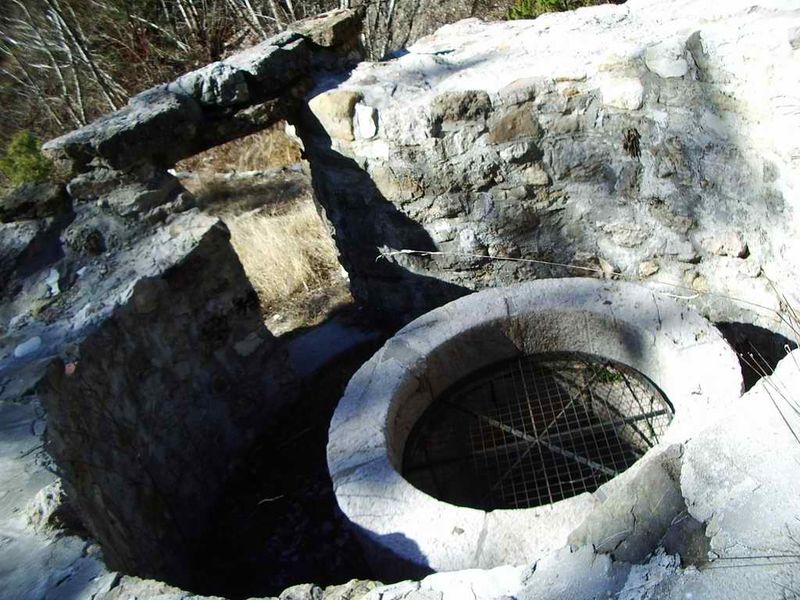
Although the well visible today dates from the 17th century, the exploitation of the salt spring dates back to the Neolithic period and continued until the 19th century.
Description
Excavations conducted at the bottom of the well between 1999 and 2002 enabled the carbon dating of a fascine of almond sticks from the first half of the 6th millennium BC (between 5800 and 5500), attesting to an extremely ancient exploitation of this salt water source. The latter was rediscovered in 1636. The masonry of the well dates from this period. The exploitation was therefore continuous until the middle of the 14th century. In 1840, a new law prohibited this type of installation. The well was closed. However, it was not destroyed as the public authorities would have liked. In 1899, the municipality had the building that housed the 17th century well rebuilt.
The excavations revealed the mining system that had been abandoned. The 1,5 m diameter well remains. Made of limestone, it is now closed by a gate. Around this well was built a large block of very large rubble. Its very specific shape (it points sharply to the north) protected the operation from the flooding of the nearby river. To the south is the door that gives access to the well. In front of this door, slightly to the east, are two rectangular tanks of approximately 2 m by 1,5 m. These salt tables, arranged in a row, were used for the evaporation of water and the concentration of salt. The first is filled; the second, a little less than 1 m deep, is paved with terracotta tiles.
source: General inventory of cultural heritage of the Provence-Alpes-Côte d'Azur region