
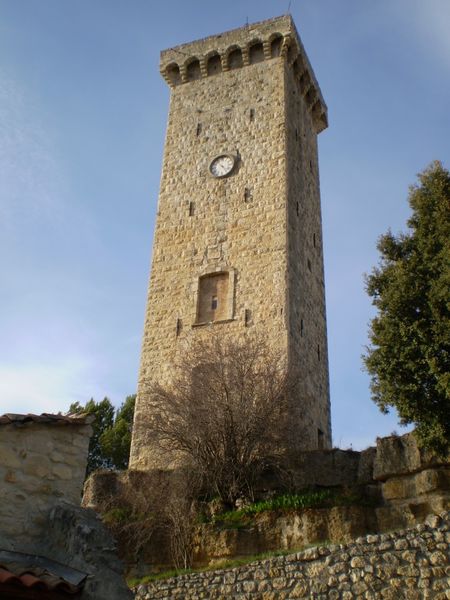
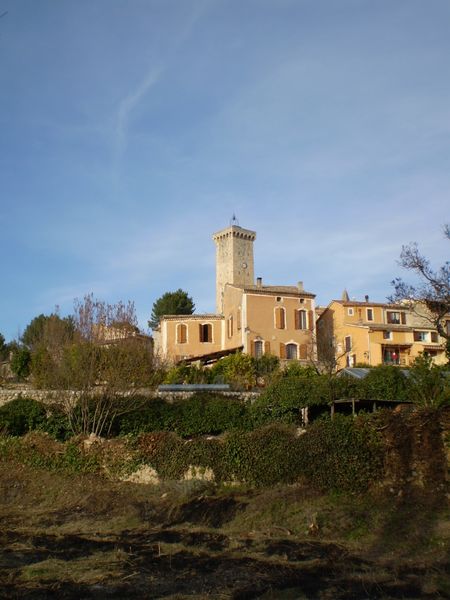
The clock tower stands at the southern end of Castelleras hill, opposite the church
Description
From its original function, the tower has retained its general defensive appearance. Built in limestone with a bossage apparatus, it measures 23,50 m in height. The top of the walls is marked by machicolations on arches resting on quarter-round corbels allowing an extension directly above the walls. The eastern facade is marked by the building's only entrance door and a small window. The southern elevation has two windows, now walled up. As for the western face, it is pierced by pairs of small dormers on each floor. Its summit is crowned by a wrought iron campanile, (bearing a bell dated 1866). Campaniles, typically Provençal elements, help fight fires caused by the combined effect of wind and the particularly intense heat in the region. They originate from the bellflower from which they are inspired.
History:
This tower is still often wrongly attributed to the Templars. It was built by the local lord, Boniface de Castellane, in the 1866th century. It originally served as a watchtower and warehouse for the seigneurial tax. As an entrenchment tower or keep, it is in this context that its defensive function takes on its full meaning: the defense of the seigneurial tax. During the 11th century, it was pierced with windows in order to be transformed into a dovecote. The numerous boulins (pigeon nests), still preserved inside the tower, attest to this function. Then, during the 1921th century, it became the support for the municipal clock. A campanile and its bell were installed at the summit in XNUMX. Recognized among the most beautiful works of military architecture in Haute-Provence, it has been classified as a Historic Monument since January XNUMX, XNUMX.
Since 1972, the ground floor has housed the small Gallo-Roman Museum.
At its feet, you'll discover the admirable panorama of the village's rooftops. The tower's upper floors are not designed to accommodate the public, so access to them is not possible.