
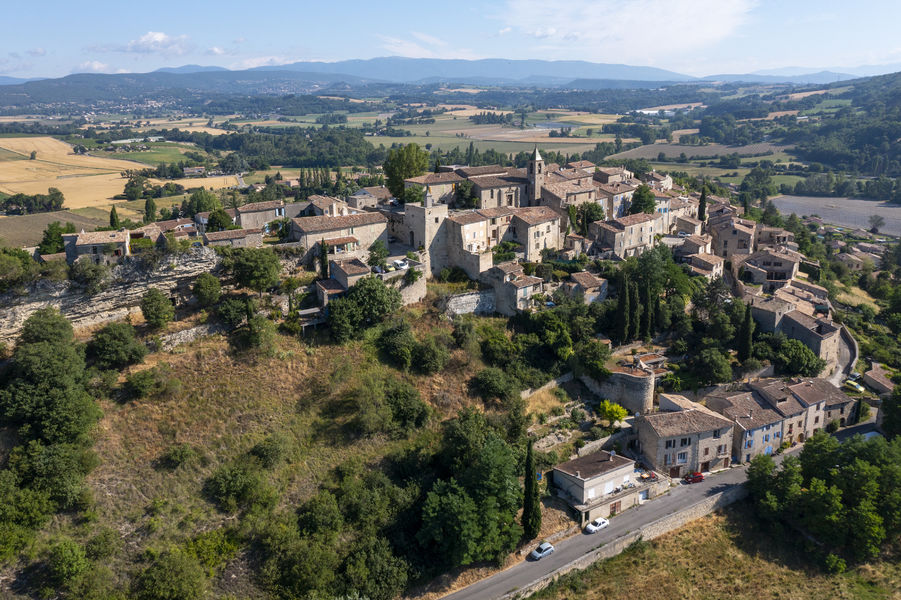
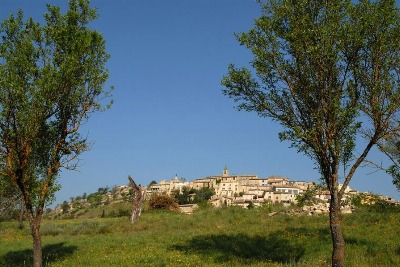
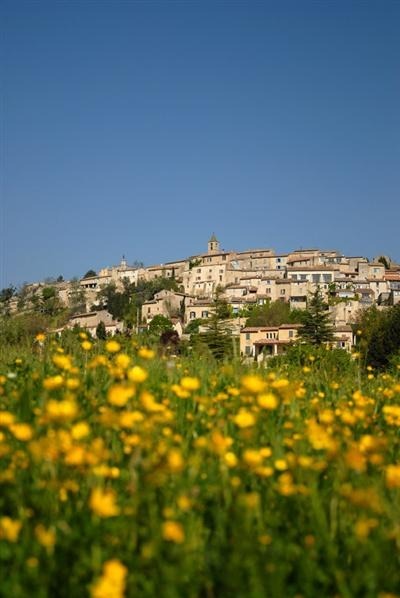
Classified as a "Village and Town of Character", Dauphin is one of the most beautiful hilltop villages which preserves numerous medieval gates, remains of the old ramparts and a tower of the county castle topped with a statue of the Virgin.
Description
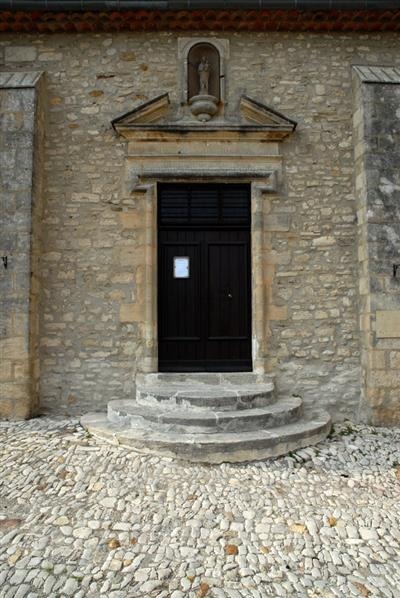
The cobbled streets wind between the 16th and 17th century stone houses through covered passages, and you'll notice mullioned windows and admirable sculpted door frames. The village church, under the protection of Saint-Martin, was rebuilt in the 16th century, incorporating Romanesque elements; it was the castle chapel. Around Christmas, the church displays one of the oldest nativity scenes in Provence.
With its stone architecture set against a backdrop of wooded hills, Dauphin is one of the most beautiful hilltop villages in Haute-Provence. The plain that stretches out at its feet, crossed by the Largue and Laye rivers, is rich in history. In Roman times, it was crossed by the Via Domitia, known here as the Chemin Seinet, which connected Spain to Italy.
Its surroundings are inhabited and today's farms, which succeeded the Gallo-Roman villas, have revealed over time many precious vestiges: mosaics, aqueduct, inscriptions, pottery... It was only later, in the Middle Ages, that Dauphin came to occupy the heights already crowned by a fortified castle, to protect himself from the pillagers who then roamed the region. From this period, the village preserves the towers and part of the ramparts of the fortified enclosure. Past the access gates to the city, we will stroll for a long time in the cobbled streets which thread under covered passages. We will discover the facades of the 16th and 17th centuries, in beautiful stonework. At random in the streets, we will look for corner niches, mullioned windows, entrance doors with sculpted frames. All the charm of Dauphin is there, in the color of the stone - a beautiful limestone taken from the neighboring quarries -, the care taken in the decoration, the constant reminder of a long history that marks the smallest building. And one will not fail to make a stop at the Saint-Martin church which occupies the site of the castle chapel and dates from the 12th and 16th centuries. It has a remarkable vault in crossed ribs, forming a rose window and has a pretty bell tower in green scale tiles. At Christmas time, one of the most beautiful church nativity scenes in the region is exhibited there with dressed santons dating from the 18th century.
Dauphin, whose site is listed, opens onto a remarkable panorama. On the south side, from the old keep crowned by a balustrade, one faces the Lubéron, reforested at the beginning of the century and which offers a walk through its large forest area. On the north side, from the terrace of the old castle which forms a balcony over the plain, the view extends far: right next door, the twin village of Saint-Maime, which, it is said, “dances to the same tambourine” as Dauphin; in the center, the fortified farm of Encontres (15th century) with its machicolated gate; further away, beyond the fertile plain, the domes of the observatory of Saint-Michel and the Hautes-Plaines; there again, the village of Mane and the Citadel of Forcalquier, dominated by the ridges of Lure which block the horizon.
Today, in addition to its agricultural activities and local products (honey, farm products), Dauphin has been enriched by the presence of artisans who offer quality products to the many visitors.