
Founded in the 13th century on the site of a former Benedictine priory, the Cordeliers Convent is one of the oldest Franciscan convents in France. It is home to the European University of Scents and Flavors.
Description
History of the Cordeliers Convent
The Cordeliers Convent is a Franciscan convent. The name Cordeliers comes from the rope around the waist. This rope is tied with three knots signifying poverty, obedience, and chastity.
Since the monks had taken a vow of poverty, they could not afford to wear a leather belt.
The Franciscan order was founded in Assisi by Francis (of Assisi!) in 1209. It is a mendicant order like the Carmelites, the Augustinians and the Dominicans.
The order quickly spread throughout southern Europe, particularly in Provence, where the Cordeliers settled in Forcalquier in 1236 on land offered by the Count. This was one of the first Franciscan convents founded in Provence.
In the Middle Ages, this building was located outside the city walls in a dangerous area. This location gave rise to its very eventful history, which began with a period of prosperity from the 13th century to around the 16th century. Around 25 to 30 monks occupied the convent during its most prosperous period.
During the Wars of Religion, the convent was pillaged and the church was transformed into a temple. The misery of the order was then accentuated in the 17th and 18th centuries by the plague epidemics (1630 and 1720).
The Revolution ruined the convent, which was partially destroyed. The last brothers were expelled (there were only three left...). The convent was sold as national property in 1791 and was gradually transformed into a farm.
In 1960, Paulette Constant carried out a major restoration of the forgotten convent. For this work, she was awarded the Masterpieces in Danger prize and the convent was listed as a supplementary historic monument.
In 2007, the City of Forcalquier completed the consolidation of the complex by acquiring the northwest wing, which underwent the most extensive renovation. Over the years, the built property was completed by the acquisition of the adjoining gardens, allowing, over 30 years, the re-creation of a homogeneous land unit around the convent of the Friars Minor.
Since the second quarter of 2009, the Couvent des Cordeliers has been enriched with new spaces and specialized equipment, thanks to the support of the UESS (€800,000 net investment), the European Union and the PACA Regional Council. 2500 m² of premises spread over 6 levels are distributed in different spaces: training, meeting and exhibition rooms, offices.
The originality of the place lies in its sensory analysis amphitheater, unique in PACA. Created in a former chapel annexed to the Convent, it houses, in addition to a professional cooking laboratory, 20 sensory analysis desks and allows both sensory analysis and consumer tests of liquids (wine, oils, etc.), foods (foodstuffs, ready meals, etc.), perfumes and aromatic compositions.
Equipped with perfume organs, this space allows the creation of scented products (eau de toilette, shower gel, room fragrances, etc.). Aiming to be modern while respecting the identity of the site, the amphitheater is equipped with state-of-the-art IT equipment offering optimal working conditions for professionals in the scent-flavor sector, students and interns that the UESS receives throughout the year.
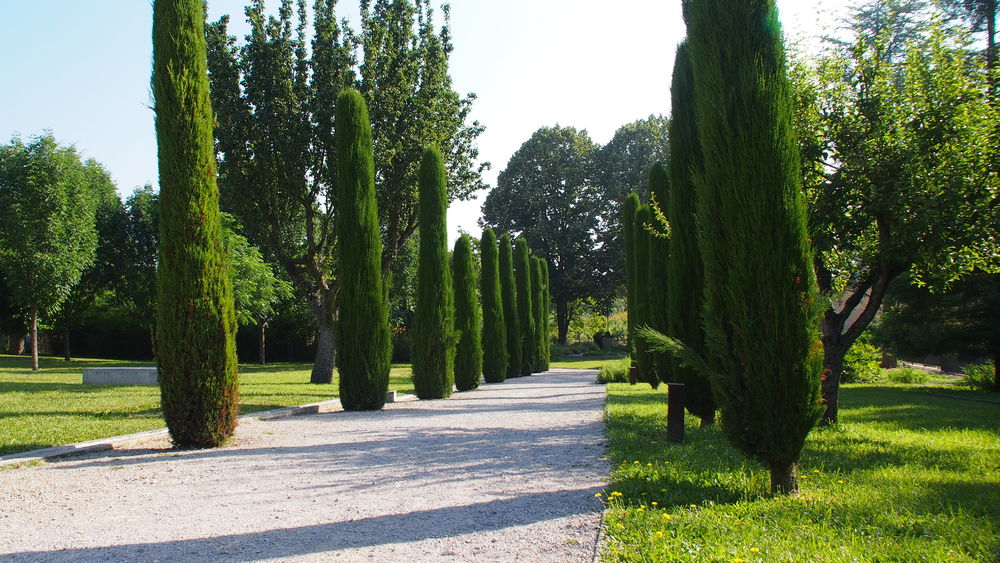
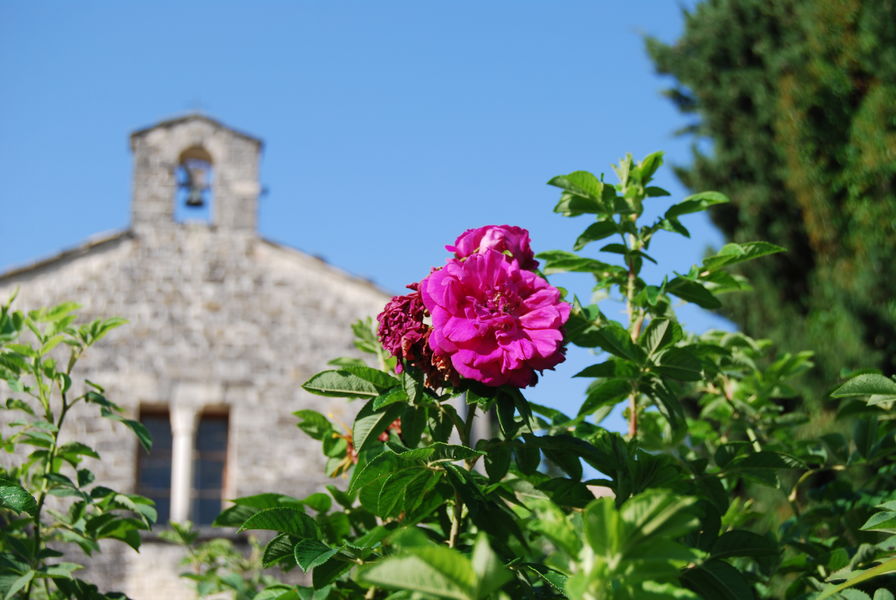
Collections of fragrant plants (peony, lily), centifolia and damaska roses, forgotten varieties of fruit trees, and fragrant trees and shrubs populate the convent grounds. A true sensory journey that ends with an explosion of scents in a rose garden created with the assistance of the L'Occitane Foundation.
Visit to the convent:
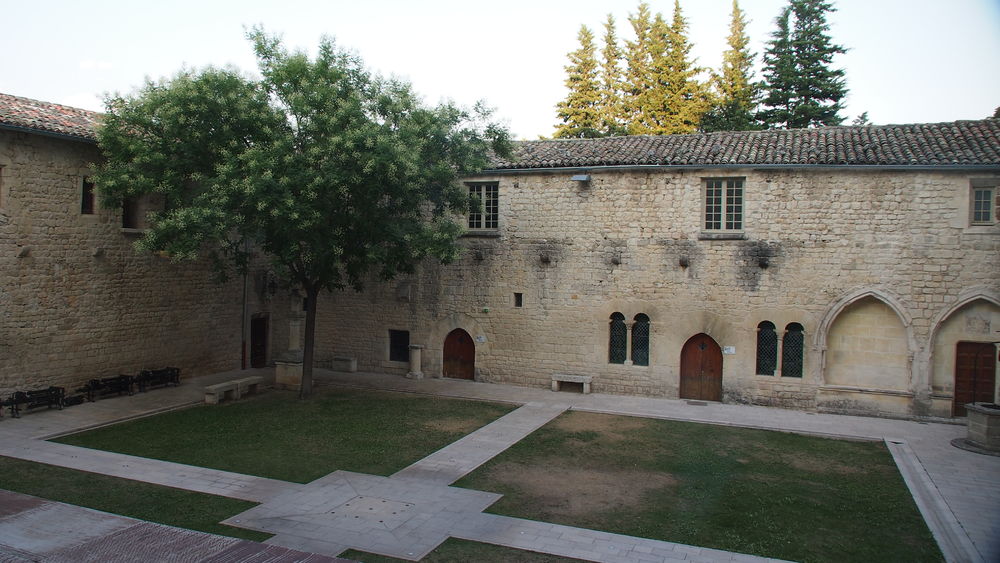
The cloister
It was covered with a wooden frame of which only the stone corbels remain. The roof rested on stone columns that have now disappeared.
The monks' cemetery was located at the center of the cloister. During the restoration in 1960, the bones were gathered under the Calvary. The latest restoration accentuates the spirituality of the place, a place of meditation and remembrance.
The northwest facade
Remodeled in the 19th century. The three Romanesque arches (authentic) lit the monks' parlor. This is also where the monks' drugstore and pharmacy were located, as well as the convent's hospitality where the unfortunate were received and cared for. This was the entrance to the convent.
The north facade
It runs alongside the refectory, a large room that often served as a meeting place for the town council. It has a single door, on the right, with a Renaissance door lintel with triple braces. This door provides access, via a spiral staircase, to the monks' cells.
On the south-eastern facade
The chapter house door, with its pointed arch, wide pecked bands, and two twin bays, dates from the 13th century. Upstairs, 13th-century openings (the smallest) illuminate the monks' ambulatory, where their cells were located.
The larger opening dates from the 19th century, as the building was no longer used as a convent, and a window was enlarged to allow more light.
Also located on the ground floor in this wing are the library and the scriptorium, the only heated room in the convent.
A word about the cells: they were simple, very modest rooms, served by a large corridor leading to the cloister. In the 3th century, comfort was very basic: a bed of three planks, a straw mattress and blankets, a table with a seat, a container of water for washing, and a box for personal belongings.
The southern facade (1260)
Corresponds to the nave of a church built after the convent (1260-1290) and which collapsed completely in 1850 due to lack of maintenance.
Presence of enfeus (lordly tombs) with the sarcophagus in the lower part containing the remains of the lord and above the family coat of arms, most of which was hammered out during the Revolution. The niche is framed by a Gothic arch resting on Gothic capitals. Only one coat of arms is still visible, that of Dame Bérengère, which says:
“In the year of our Lord 1280, on the calends of April (first day), the venerable Lady Bérengère, lord of the castle of Saint-Maime, died.” Village located 8 km from Forcalquier.
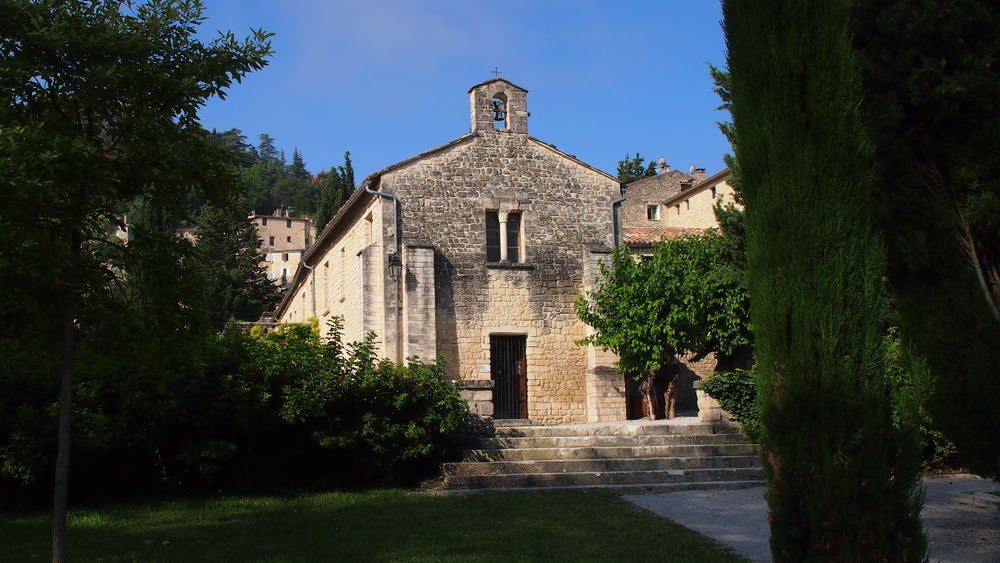
The chapel
Beneath the modern plasterwork, a twin bay window was discovered, which, in the 12th century, lit the gallery. This gallery was removed in the 14th century to add additional cells upstairs. Modern buttresses stabilize the building.
Church and eastern facade of the convent, in front of the apse of the church
The entrance to the church was through the triple Gothic portal on the street side. It was a church of Romanesque architecture, very simple, 45 m long, formed by the nave and the choir, separated by a triumphal arch supported by a triple column still visible. The nave was timber-framed. The church ends before us with the flat chevet and two diagonal buttresses.
The (modern) coat of arms behind the church
Gift from Paulette Constant, and according to her:
The clothed hand is that of Saint Francis
The unclothed hand is that of Jesus
Above, the T (Greek tau), used by Saint Francis for baptizing (symbol of the cross). The crown of the Counts of Forcalquier.
Comfort and amenities
Services
Equipment
Activities
Rates / opening
Prices
Free access.
Opening
All year round, every day.