
“West Luberon” tourist itinerary: Discover the Manosque hinterland, its somewhat wild nature and its small Provençal villages perched on their rocks, overlooking the valley rich in green and varied nature.
Description
This pleasant tour combining historical, cultural and natural heritage allows you to immerse yourself in the heart of the Luberon Regional Natural Park to discover Haute-Provence.
Itinerary:
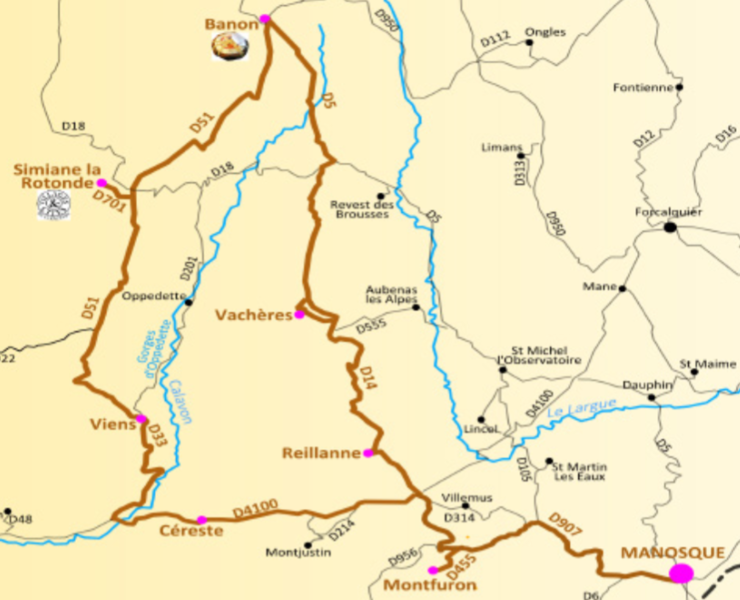
From Manosque, take the D907 towards Apt and make a detour to Montfuron, this charming village, perched at an altitude of 675 m. Its windmill, built 350 years ago and very well preserved, sits on its highest hill.
Points of interest:
Manosque
• Historic city center
• Saunerie and Soubeyran Gates
• Saint-Sauveur Church
• Private mansions
• Jean Giono Cultural Center
• All Aures Hill (Chapel)
• Mont d'Or Hill (remains of a castle from the
10th century)
• L'Occitane factory, garden and museum
• Vannades lake
• Olivette Mill
• La Thomassine: orchards and conservation gardens
• Randoland (fun tour circuit to discover
with family)
Montfuron
• Notre-Dame Saint-Elzéard stone church
dry
• Windmill built under Louis XIV
• Saint-Elzéard Chapel (12th century)
• Belvedere with orientation table
• Sundial
Continue along the D907 to reach the intersection with the D4100. Take the D14 road in front of you, which heads towards Reillanne. This village has a long prehistoric history, which is recounted along its narrow streets.
Points of interest:
Reillane
• Church of Our Lady of the Assumption (11th century)
• Saint-Denis Chapel (18th c.)
• Character houses
• Covered passages, squares, fountains,
doors...
• Saint-Pierre Towers (11th century)
• Sundial
• Museum of Friends of the Arts
Return to the road and follow the direction of Vachères. This harmoniously constructed medieval village has been carefully restored.
Points of interest:
Cowherds
• Romanesque Church of Notre-Dame de Bellevue
• Saint-Christophe Church (exhibitions, concerts)
• Museum of Paleontology and Archaeology
Pierre Martel
Then, continue towards Banon, perched at 800 m, and famous for its goat cheeses as well as its bookstore "Le Bleuet". Then go back down towards the south on the D51 towards Simiane la Rotonde. There is no shortage of architectural curiosities in this village dating from the Middle Ages and the Renaissance, classified as a "City of Character". On the slope facing the village, you can see the Abbey of Valsaintes. Don't miss a stop there to explore this incredible rose garden with a thousand scents.
Points of interest:
Well no
• Former Hôtel-Dieu
• Ramparts (15th century) and machicolated gate
(14th c.)
• Beautiful houses (16th c.)
• Arcaded alleys
• Cheese dairy ecomuseum (cheese from
Banon)
Simiane the Rotunda
• Rotunda of the Templar castle (12th century)
• Sainte-Victoire Church (12th century)
• Private mansions, beautiful facades, doors
carved, ornate windows...
Continue the route and reach Viens, the small village in Vaucluse. Perched on its rocky peak, it has retained its medieval stronghold look. Then take the D33 road to Céreste. Your return journey ends in Manosque.
via the D4100 and D907.
Points of interest:
Come
• Castle (16th c.)
• Saint-Hilaire Church (16th/17th c.)
• Saint-Férréol Romanesque Chapel
• Saracen Gate
• Clock Tower
• 13th century residences.
• Communal oven on Notre-Dame Street
Cereste
• Saint-Michel Church (18th c.)
• Stone facades and houses (15th/18th c.)
• Fountains, dovecotes, ancient fords...
• Cobbled streets
• Roman bridge (Encrême ravine)
• Troglodyte dwellings
• Priory of Carluc (12th century)
Type : Loop
Distance : 195km
Duration : 0 min
Cartographic references
The Tourist Map of Haute Provence, Pays de Manosque, can be downloaded from our websites or collected from the Manosque Tourist Office
Other details
Winding and narrow road
Comfort and amenities
Services
Equipment
Rates / opening
Prices
Free access.