

Distance 4.2km
Elevation 194m
Duration 2h
Hike combining forest, viewpoints, heritage and agriculture.
Description
The ancients, at the beginning of the 20th century, called it "the way of the Calvary", without anyone knowing exactly where this Calvary could be or what it looked like: not the slightest trace of it has ever been found. Unless it was the ordeal of the poor inhabitants forced to take this steep and arduous path to reach the threshing floor and the olive groves which then covered the hillside!
The departure is from the car park in the Bernards district, in the Fouent valley, at the foot of the threshing floor (1) which constitutes the first stage (see the chapter dedicated to it).
We then follow the yellow-marked path through lands (2) exposed to the sun and far from the winter chill where the Castellians once planted olive groves. From there we can enjoy a beautiful view of the village.
We then continue along the path, which splits into two. We take the "alternative" path, which is a few dozen meters higher than the normal path. However, there is no difference in the landscape.
The two options quickly come together, a few hundred meters further on, almost at the end of the south-facing hillside, right at the junction of a path offering an alternative route (blue markings and dotted lines on the map).
All along the path, you can see the remains of pebble walls, evidence of the ancient occupation of the land by agriculture, which hunted down every corner of favorable land, as well as traces of black earth, the remains of the charcoal pits that the ancients had established to produce a popular fuel.
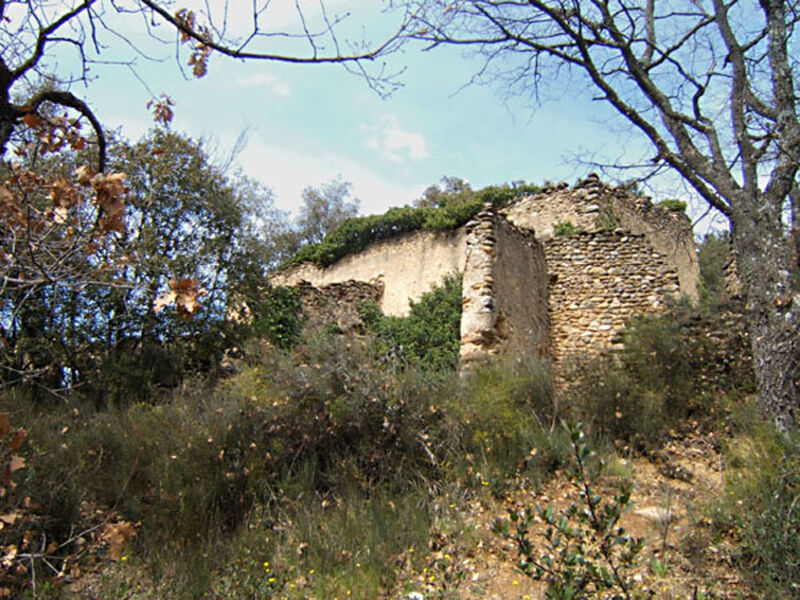
We go back up towards the northwest, on the side of the Château-Levin valley, and we arrive at the first ruins (3) which mark the human presence at a time when these hills were cared for and cultivated.
We now continue the path to the bottom of the valley through vegetation that suddenly becomes greener and more luxuriant, proof of the presence of water. Looking at the other side of the valley we can see another ruin.
The yellow trail now crosses the track marked at the bottom of the valley. We are in the middle of the ONF national forest and the track is closed to all traffic (red line on the map). We can continue straight ahead on the yellow trail. Arriving at the ridges (4) this trail crosses a cedar plantation. The vegetation then varies throughout the walk (5), with wild cherry trees and Aleppo pines. Here the rehabilitation of an olive grove provides a beautiful panorama of Entrevennes and the Montdenier massif. Then botany enthusiasts will delight in the variety of trees in the forest (6) that we pass through: maritime pines, Kefalonian firs, Scots pines, Austrian black pines, Atlas cedars and oaks share the land. We now begin the descent towards the parking lot via the Fouent valley, not without passing in front of the captured spring that partly supplies the village. We could just as easily have gone back up the red trail towards the north: we would then have encountered different broadleaf trees: acacia walnut trees, downy oaks, holm oaks, wild cherry trees, hackberry trees, Montpellier maples, field maples and even a chestnut tree in front of the ruin.
Finally, a third variation of this route begins in the Château-Levin valley and consists of going back down to the village as quickly as possible instead of continuing along the yellow path or going up the red trail. We then pass in front of the Château-Levin spring, which explains this change in vegetation. And we quickly arrive at the barrier that closes the trail.
There, a clump of cedars adorns the parking area (7). A few hundred meters further and you reach the paved road that leads back to the parking lot. Throughout the walk, discreet hikers will have been able to spot a variety of wildlife, including woodpeckers.
Note: Numbers in parentheses refer to points on the plane.
Type : Round trip
Distance : 4.2km
Elevation : 194m
Duration : 2h
Average altitude : 578m
Max altitude : 661m
Cartographic references
IGN TOP 25 Map Blue Series 3342 OT PLATEAU DE VALENSOLE