
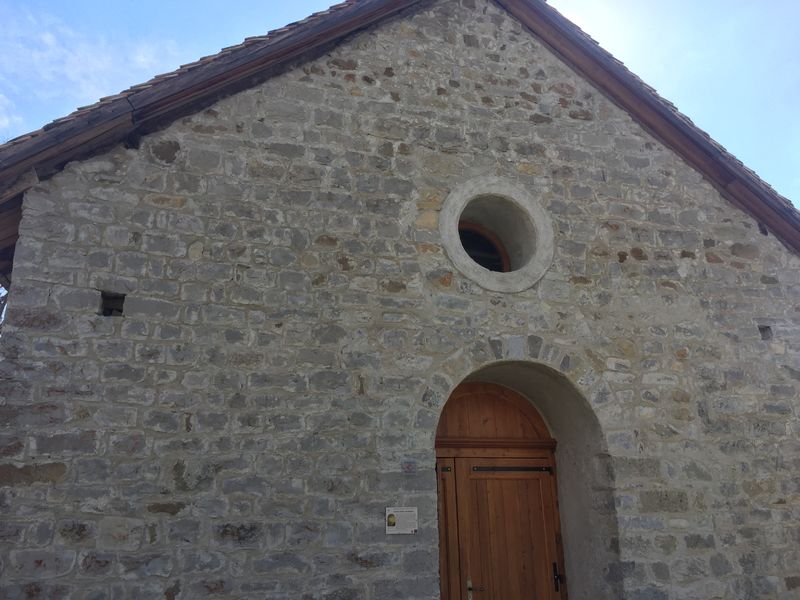


Thorame's heritage is rich, reflecting its history. Eturamina, the capital of the Roman city, became the seat of a bishopric in the 5th century. Although traces of this period are known, much of its history remains to be discovered.
Description
1 - Mill Bridge (1688)
Listed as a historic monument, on the edge of the RD 908. Departure of the rehabilitated path on the other side of the road, we cross the Riou Sec bridge, we join the RD 52 then the village
2 - St. Anthony's Oratory
3 - St-Roch Chapel
The Saint-Roch chapel is part of a group of oratories, chapels, and crosses that signal and protect arrivals in the village. Saint Roch is invoked against contagious diseases, particularly the plague, which ravaged Provence several times in the 17th and 18th centuries.
Hard hit in 1630 with nearly 80 deaths, the inhabitants of Thorame-Haute reacted effectively during the epidemic of 1720, ensuring a guard of nine men day and night at all entrances to the village. Graffiti counting down the days on the walls of the chapel suggest that it may have been one of these guard posts.
4 - St-Honorat Oratory
5 - Maison Brieu
This vast building complex was once the residence of the Boyer family, wealthy merchants from Thorame. From at least the 17th century and until the first half of the 19th century, they played an important role in the economic life of the village.
The current building, dating from the end of the 18th century, still retains some remarkable features: wrought iron balustrade, fireplaces, molded ceilings, stables and a cobbled courtyard with its old fountain and warehouses.
An adjoining orchard of 2790 m² completed the complex. The current name "Maison Brieu" may have come from a simple corruption of the name Boyer. Developed in the 1970s, it now houses municipal housing.
6 - St George's Parish Church
Of the old church, destroyed in 1390 by Raimond de Turenne and then in 1574 by the Baron of Allemagne, only two pillars and a dedication from 1539 seem to remain.
The ribbed vaulted choir was rebuilt from 1598 and the nave only received its masonry vault in the middle of the 19th century, at the same time as stained glass windows, a terracotta high altar from the Virebent establishments in Toulouse and a rich neo-Gothic painted decoration signed Lamberty in 1898.
The building contains several listed 17th-century altarpieces, including two paintings by the Digne-les-Bains painter Antoine Rouvier. The choir houses the statue of Saint Julien-Martyr, patron saint of Thorame-Haute, carried in procession through the village streets on the day of the patronal feast.
The Rosary Chapel houses a painting by Fidèle Patritti (1811-1867), an Italian painter who lived in Jausiers, in a remarkable gilded wooden altarpiece dating from 1746, as well as the miraculous statue of Our Lady of the Flower, carried in procession on Whit Monday.
7 St-Joseph Chapel
It belongs to a group of oratories, chapels and crosses that signal and protect the arrival in the village. Its typically Alpine architecture designates it both as a shelter for travelers and as an oratory, opened by a turned wooden screen that reveals the statue of the saint to be invoked for protection.
The cult of Saint Joseph grew rapidly at the end of the 16th century. His appearance to a shepherd in Cotignac in 1660 had a profound impact on the minds of all of France, right up to King Louis XIV, who dedicated France to him in 1661.
His cult encourages the believer to take Saint Joseph as a model for life. The values he promotes evoke the concrete concerns of past village life: humility, hard work, family peace, which should lead the believer to a good death, in serenity and surrounded by his loved ones.
8 -Our Lady of Serret
This ancient parish church, surrounded by ancient remains, preserves the memory of a primitive settlement, perhaps dating back to the 5th century and the ephemeral bishopric of Eturamina, the location of which is uncertain today.
Around the year 1000, it became a priory dependent on St-Victor de Marseille, and was endowed by the lords of Thorame with land, pastures and mills. Its fine cut stonework could date back to this period.
Deserted by its parishioners after the Wars of Religion, it became a simple vicarage in the 16th century. Its condition deteriorated over the following centuries until its restoration in 1786, as evidenced by a dated tile found on its roof.
Abandoned during the 19th century, it served as a warehouse in the 20th century, before the PCTH association and the Municipality began its restoration. It now hosts a variety of cultural events.
9 - Chemin de Sainte-Guite (old road to Digne).
This path takes you to Lake Sagnes. You will follow part of the old communication route linking the upper Verdon Valley to Digne-les-Bains, via Thorame-Haute, Thorame-Basse and the Séoune and Cine passes.
This section, located in the Tourneirons district, begins in the black earth of the roubines, at a place formerly called Sainte Agathe. It housed an oratory dedicated to her, the cult of which is forgotten.
Abandoned at the end of the 19th century to be replaced by the current departmental road no. 2, this section was reopened thanks to the work of a volunteer and the Municipality.
The Thorame-Haute heritage trails are an entirely voluntary creation of Thorame-Haute Cultural Heritage (association under the 1901 law founded in 1991), with the support of the
Commune.
Type : Marked roaming
Distance : 2km
Duration : 2h
Difficulty : Easy
Average altitude : 1119m
Max altitude : 1155m
Marking details
specific panels
Rates / opening
Prices
Free access.
Opening
Open all year round.