
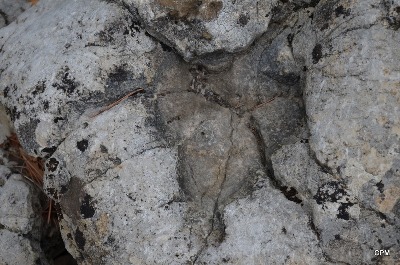
It was discovered in the Coste Longue stream by Michel Flaven and was authenticated as a ronzotherium from the Oligocene (30 MA) in 2003 by Loïc Costeur, a researcher at the CNRS.
Description
It is distinguished by a sole with three pads and three toes. These prints are those of a distant cousin of the rhinoceros, which lived in a region of large brackish water lakes, at the bottom of which very thick sediments accumulated, including more than 800 m of salt, in which petroleum products and gas are currently stored.
Due to an exceptional climatic phenomenon, this mud dried, hardened and petrified quickly, without erosion or erasure, and has reached us.
The slab is in the national inventory of geological heritage of the National Museum of Natural History.
Rates / opening
Prices
Free access.
Opening
From 01/01 to 31/12 every day.